Showing posts with label Human Nature. Show all posts

Friday, August 28, 2015

Belonging


The last entry looked at how we as humans can use strength and weakness to live with others. Becoming human is a struggle of finding your strength in weakness. For the following entry I would like to look at belonging and what it means to belong. Living in Canada this can be a difficult task because of the multicultural environment we find ourselves living in. Toronto is culturally the most diverse city in the world. What does it mean to belong?

Belonging, like anything else, can be a place of opening up as well as a place of closing in. It is a place where we discover what makes our humanity. Family, language, humanhood, culture, food, communication, love and respect for others sums up this notion of belonging. If we accept this then we must accept that at the heart of belonging, is the fact that, we have received our existence from others and need to grow and develop as individuals, physically, psychologically, and humanly.

Let's use the example of a child to see how a child can become a product of the society that we build around ourselves. Belonging is not an individual act but involves an entire group. The child goes to school, shares in the life of the community, and discovers a wider sense of belonging with others from the same city, region, country, religion, language and culture. Sometimes the child meets people who are different, strangers, people with disabilities, immigrants, people from different religious backgrounds etc. The child will quickly pick up, through the adults attitude whether such people are to be accepted and loved or ignored, or even ostracized because they do not belong. And so from a young age we learn, without realizing it, that those who are different, those who standout, are either acceptable or dangerous.

When a child acquires a language and learns how to relate to adults, to friends, to God, when he learns the customs and values that have been taught to him through his culture, how to deal with death, pain, sorrow, he cannot but think that what he has been taught is the only way of being and living. As children we learn that there is a right way and a wrong way of doing everything. We do not ask questions instead, we obey. As we grow to adulthood we begin to questions the values learned during our childhood. This is why many adults and youth go through a crisis of faith and of trust. Belonging begins from day one. We must constantly seek to grow our humanity by accepting everyone as a human being. "Differences" should never be a factor in accepting others. Let us cultivate a society that nurtures the ideals of love and acceptance no matter how one looks, talks, or eats. To be a human is to belong and to belong is to love all without any pretext or conditions. Love is at the heart of belonging and once we belong to a community we learn to love unconditionally.

Wednesday, August 12, 2015

Strength in Weakness


The last entry looked at the humanistic approach involved in Chaplaincy. I would like to expand this and speak on what it means to be weak and how this relates to becoming a human being. Becoming human is a title for many books written in the last century. Authors like Jean Vanier, John Behr and Olivier Clement have written on what it means to become a human. Becoming human, I can define from reading these books, is based on the idea of constantly seeking the good and beautiful in all that we do. In order to seek the good and beautiful we must however understand that, in order to find beauty and goodness, we must come from a place of weakness.

The paradox of weakness and strength can be difficult to understand. One can say, "How can I find beauty and goodness when I am lying in a hospital bed and I do not have control over the condition that has taken a hold of me?" People are infuriated by weakness that sometimes even the beautiful cry of a child can be a distraction. Weakness awakens hardness and anger in all of us. Equally dangerous, sometimes less obvious, weakness can lead people to a possessive love. However, in this mystery of weakness it can open our hearts to compassion; the place where we are concerned for the growth and well-being of the weak.

I see this on many levels in the hospital. The nurse, doctor, physiotherapist, occupational therapist and many more constantly seek to help others who are in a position of weakness trying to restore them to a position of strength. To deny weakness as a part of life is to deny death, because weakness speaks to our ultimate destruction of not being in control which is death itself. To be sick or dying is a stage of weakness and as that weakness becomes more apparent we begin to deny it all together.

If we deny our weakness and the reality of death by constantly seeking to be powerful and strong, then we deny part of our being creating a space of illusion, a bubble that becomes harder to break. To be a human being is to accept who we are, this mixture of strength and weakness. To be human is to be bonded to each other with our weakness and strengths, because we need each other. Lastly, weakness that is recognized, accepted and offered back is at the heart of belonging, which brings us together as a community of love.

I leave you with the beautiful words of Jean Vanier. Jean Vanier published a book called Becoming Human, inspiring me to write this post. I recommend this book to anyone who is interested in wanting to understand and grow their knowledge of what it means to become a human being.

Weakness carries within it a secret power. The cry and the trust that flow from weakness can open up hearts. The one who is weaker can call forth powers of love in the one who is stronger. Do those who are stronger respond with love because in an unconscious way they identify with the one who is weak? Do they, in some way, know that one day they too will be weak and will cry out for help, recognition, and love?       

Jean Vanier, Becoming Human, 40. 

Saturday, August 1, 2015

The Humanistic Approach to Chaplaincy


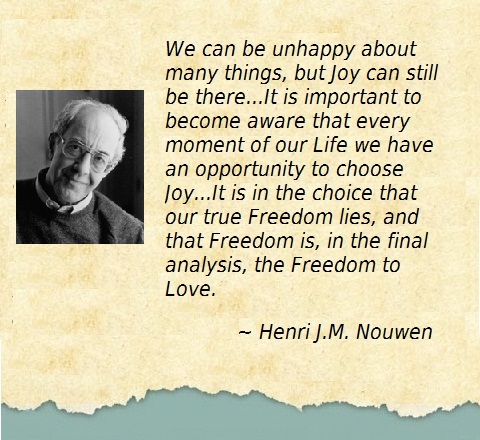
One aspect that has really caught my attention during the last six months is a concept that has been popularized by Henri Nouwen. The wounded healer is the affirmation that all humans are wounded yet we find healing through the same wounds that make us vulnerable with each other. Henri Nouwen sums up the role of the priest, pastor, imam, rabbi, pendant etc. beautifully connecting the role to the wounded healer:

The Christian leader, minister or priest, is not one who reveals God to the people-who gives something to those who have nothing-but one who helps those who are searching to discover reality as the source of their existence. In this sense we can say that the Christian leader leads humans to confession, in the classic sense of the word: to the basic affirmation that humans are human and God is God, and that without God, humans cannot be called human. The Wounded Healer, Page 43.

The Humanistic approach to providing care was made popular following World War 2 by Carl Rogers. Carl Rogers was an influential American psychologist and was one of the main founders of the humanistic approach (client-centered care) in the medical field. This approach seeks to understand human personalities and human relationships in order to provide counseling, psychotherapy and education to all. Rogers was found to be the 6th most eminent psychologist of the 20th century and second, among clinicians, only to Sigmund Freud. The overall understanding of the humanistic approach can be summed up in the following manner: 

"Before every session, I take a moment to remember my humanity, there is no experience that this man or women has that I cannot share with them, no fear that I cannot understand, no suffering that I cannot care about, because I too am human. No matter how deep there wound, they do not need to be ashamed in front of me. I too am vulnerable. And because of this, I am enough. Whatever their story, they no longer need to be alone with it. This is what will allow there healing to begin". Carl Rogers. 

The broken human being is the paradigm into which healing can begin. If the chaplain or any medical care provider begins to understand their own brokenness and see that it can be used as a way to heal others then this is the starting point in which everyone can be restored in that image and likeness that God intended us to be fashioned in. One aspect of the humanistic approach deals with the development of personality. The last step to be achieved in the personality development is the "rich and full life". Carl Rogers summarizes this in the following way:  

"This process of the good life is not, I am convinced, a life for the faint-hearted. It involves the stretching and growing of becoming more and more of one's potentialities. It involves the courage to be. It means launching oneself fully into the stream of life". Carl Rogers, 1961.

Becoming a human being is a process that consists of struggles and pains. The humanistic approach speaks to this struggle and challenges us to open ourselves and become vulnerable so that we can seek healing from those who are integrated in our lives. If we cannot open up as human beings then we cannot begin to understand the struggles and the pains that our patients and loved ones go through. Becoming human involves the process of being, living and opening up ourselves to pain and sorrow. Once we open ourselves we can start to heal and become healers for everyone.  


Saturday, January 10, 2015

The Minister and Inner Events: Discovering our Humanity


Henri Nouwen was a Roman Catholic priest and probably one of the greatest spiritual writers of the 20th century. In this hope-filled and profoundly simple book, Henri Nouwen offers a radically fresh interpretation of how we can best serve others. Here he inspires devoted men and women who want to be of service in their church or community, but who have found some traditional practices of outreach alienating an ineffective. Weaving keen cultural analysis  with his psychological and religious insights, Nouwen has come up with a balanced and creative theology of service that begins with the realization of fundamental woundedness in human nature.

According to Nouwen, ministers are called to identify the suffering in their own hearts and make that recognition the starting point of their service. For Nouwen, ministers must be willing to go beyond their professional, somewhat aloof, roles and leave themselves open as fellow human beings with the same wounds and suffering as those whom they serve. In other words, we heal from our wounds. Nouwen describes wounded healers as individuals who "must look after their won wounds but at the same time be prepared to heal the wounds of others". The minister is the one who wants to serve others however, the minister is a wounded person.

I hope to present a few passages from the book in the next few entries that will help anyone who serves guide them on their journey.    

_____________________________________

This might sound highly theoretical, but the concrete consequences are obvious. In practically all priestly functions, such as pastoral conversation, preaching, teaching, and liturgy, the minister tries to help people to recognize the work of god in themselves. The Christian leader, minister or priest, is not one who reveals God to the people-who gives something to those who have nothing-but one who helps those who are searching to discover reality as the source of their existence. In this sense we can say that the Christian leader leads humans to confession, in the classic sense of the word: to the basic affirmation that humans are human and God is God, and that without God, humans cannot be called human.

In this context, pastoral conversation is not merely a skillful use of conversational techniques to manipulate people into the Kingdom of God, but a deep human encounter in which people are willing to put their own faith and doubt, their own hope and despair, their own light and darkness at the disposal of others who want to find a way through their confusion and touch the solid core of life.

In this context, preaching means more than handing over a tradition; it is, rather, the careful and sensitive articulation of what is happening in the community so that those who listen can say: "You say what I only suspected, you clearly express what I vaguely felt, you bring to the fore what I fearfully kept in the back of my mind. Yes, yes-you say who we are, you recognize our condition."

When someone who listens is able to say this, then the ground is broken for others to receive the Word of God. And no minister need doubt that the Word will be received! The young especially do not have to run away from their fears and hopes but can see themselves in the face of the one who leads them; the minister will make them understand the words of salvation which in the past often sounded to them like words from a strange and unfamiliar world.

Teaching in this context does not mean telling the old story over and over again, but the offering of channels through which people can discover themselves, clarify their own experiences, and find the niches in which the Word of God can take firm hold. And finally, in this context liturgy is much more than ritual. It can become a true celebration when the liturgical leader is able to name the space where joy and sorrow touch each other as the place in which it is possible to celebrate both life and death.

So the first and most basic task of contemporary Christian leaders is to lead people out of the land of confusion into the land of hope. Therefore, they must first have the courage to be explorers of the new territory within themselves and to articulate their discoveries as a service to the inward generations.


Henri Nouwen, The Wounded Healer: Ministry for a Rootless Generations, 43-44.


Monday, May 12, 2014

The Theology of Illness-The Healing of Human Nature by the Incarnate Word


Jean-Claude Larchet, a french laymen who teaches philosophy in France has written a book on the theology of illness. Throughout the book his aim is to show the connection between illness and sin and how this connection is related to our present reality. The first chapter examines the nature of sin and he breaks down sin using the Patristic fathers. The remainder of the book looks at the relationship with sin, illness and how modern medicine has completely neglected the human being. The treatment of the human being and to see a human being is being neglected as modern medicine keeps pushing for more ways to extend life forgetting to see the real life in that lies right in front of there eyes. I recommend this book highly especially for those in the medical world. The following is a small section from the book dealing with our healing related to the incarnation of God.

________________________________________

Only Christ can deliver mankind from the consequences of Adam’s transgression and from sin itself. As a divine Person, He is able to “enhypostasize” the fullness of human nature. Thereby He assumes human nature totally, restores it by the power of His own divine nature, and reunites and conforms it in Himself to divinity. Thereby He becomes the New Adam, but an Adam who is perfectly fulfilled; and thereby He fully accomplishes the divine plan which the first man failed to bring to completion. “Thus as one mans trespass led to condemnation for all men, so one man’s act of righteousness leads to acquittal and life for all men. For as by one mans disobedience many were made sinners, so by one mans obedience many will be made righteous” (Rom 5:18-19). Human nature, fallen in Adam, is restored in Christ and recovers all of the privileges it knew in its prelapsarian state. In the words of St Cyril of Alexandria, “As in Adam man’s nature fell ill from corruption, [. . .] so in Christ it has recovered health.” By His Incarnation, Christ has overthrown the barrier which separated our nature from God and has opened that nature once more to the deifying energies of uncreated grace. By His redemptive work, He has freed us from the tyranny of the devil and destroyed the power of sin. By His death, He has triumphed over death and corruption. By His resurrection, He has granted us new and eternal life. And it is not only human nature, but also the creation as a whole which Christ heals and restores, by uniting it in Himself with God the Father, thereby abolishing the divisions and ending the disorders that reigned within it because of sin.

“God,” St Maximus writes, “became man in order to save nun from destruction. By reuniting in Himself the ruptures in the universal nature ... He accomplished the great work of God the Father by recapitulating all things—things in heaven and things on earth—in Himself, in whom they also were created___First of all He united us in Himself, rendering us in total conformity to Himself. Thereby he restored in us His image, pure and whole, which none of the symptoms of corruption could touch. With us and for us He embraced the entire creation. . . . He recapitulated all things in Himself, thereby showing that the entire universe is one, as if it were itself and in its own manner a human person, fulfilled completely by the reuniting of its various members. . . . He brought to unity those things that had been separated; He put an end to the internal war between created beings, joining together in peace and unbreachable harmony all things both in heaven and on earth".

+ Jean-Claude Larchet, The Theology of Illness, SVS Press, p.40-41.