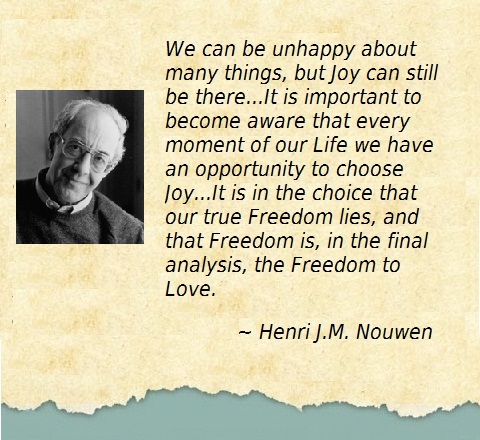
Showing posts with label Fr. Henri Nouwen. Show all posts

Tuesday, December 22, 2015

The Joy that allows for a Peaceful Death


The following is a excerpt from Henri Nouwen's On Dying and Caring. He speaks about two kinds of joy and paints an image of what it means to die a peaceful death. I hope this resonates with all of you as it did with me.

____________________________

Two of the greatest joys experienced are the joy of being different from others and the joy of being the same as others. The first of these I saw while watching the 1992 Olympics in Barcelona on television. Those who stood on the rostrum and received their bronze, silver, and gold medals experienced joy as the direct result of being able to run faster, jump higher, or throw farther than others. The difference might have been extremely small, but it had great significance. It was the distinction between defeat and victory, between rueful tears and ecstatic joy. This is the joy of the hero and the star, the joy that comes from successfully competing, winning the prize, receiving the honor, and walking into the limelight.

I know this joy myself. I know it from getting an award at school, from being chosen the leader of my class, from receiving tenure at the university, and from seeing my books published and receiving honorary degrees. I know the immense satisfaction that comes from being considered different from others. These types of achievements dispel self-doubts and bestow self-confidence. This is the joy having “made it”, the joy of being recognized for making a difference. We all wait for this joy somewhere, somehow. It remains the joy of the one who said, “I thank you God, that I am not like everyone else” (Luke 18:11-12).

The other kind of joy is harder to describe but easier to find. It is the joy of being the brother or sister of all people. Although this joy is closer at hand-more accessible-than the joy of being different, it is not as obvious, and only a few people ever truly find it. This is the joy of being a part of that vast variety of people-of all ages, colors, and religions-who together form the human family. This is the immense joy of being a member of the human race.  

At several times in my life, I have tasted this joy. I felt it most acutely in 1964, when I walked with thousands of people in Alabama from Selma to Montgomery in a civil rights march led by Martin Luther King, Jr. I will never forget the joy I experienced during that march. I had come by myself. Nobody knew me-nobody had ever heard of me-but when we walked together and put our arms around each other’s shoulders and sang “We shall overcome one day,” I experienced a joy I had never experienced before in my life. I said to myself, “Yes, yes, I belong; these are my people. They may have different way of life, but they are my brothers and sisters. They love me, and I love them. Their smiles and tears are my smiles and tears; their prayers and prophecies are my prayers and prophecies; their anguish and hope are my anguish and hope. I am one with them”.

In an instant, all differences seemed to melt away as snow in the sun. All my comparing disappeared, and I felt surrounded by the welcoming arms of all humanity. I was aware that some of the people with whom I held hands had spent years in prison, were addicted to drugs or alcohol, suffered from loneliness and depression, and lived lives radically different from mine, but they all looked to me like saints, radiant with God’s love. They were indeed God’s people, immensely loved and radically forgiven. All I felt was a deep sameness, a profound communion with all people, an exhilarating sense of brotherhood and sisterhood.

I am convinced that it is this joy-the joy of being the same as others, of belonging to one human family-that allows us to die well. I do not know how I or anyone else could be prepared to die if we were mainly concerned about trophies we had collected during our best years. The great gift hidden in our saying is the gift of unity with all people. However different we are, we were all born powerless, as we all die powerless, and the little differences we live in between dwindle in the light of this enormous truth. Often this human truth is presented as a reason to be sad. It is not seldom called a “sobering truth”. Our greatest challenge is to discover this truth as a source of immense joy that will set us free to embrace our mortality with the awareness that we will make our passage to new life in solidarity with all the people of the earth.


A good death is a death in solidarity with others. To prepare ourselves for a good death, we must develop or deepen this sense of solidarity. If we live toward death as toward an event that separates us from people, death cannot be other than a sad and sorrowful event. But if we grow in awareness that our mortality, more than anything else, will lead us into solidarity with others, then death can become a celebration of our unity with the human race. Instead of separating us from others, death can unite us with others; instead of being sorrowful, it can give rise to new joy; instead of simply ending life, it can begin something new. 

Henri Nouwen, Our Greatest Gift: A Meditation on Dying and Caring, Pages 21-24.

Friday, August 28, 2015

Belonging


The last entry looked at how we as humans can use strength and weakness to live with others. Becoming human is a struggle of finding your strength in weakness. For the following entry I would like to look at belonging and what it means to belong. Living in Canada this can be a difficult task because of the multicultural environment we find ourselves living in. Toronto is culturally the most diverse city in the world. What does it mean to belong?

Belonging, like anything else, can be a place of opening up as well as a place of closing in. It is a place where we discover what makes our humanity. Family, language, humanhood, culture, food, communication, love and respect for others sums up this notion of belonging. If we accept this then we must accept that at the heart of belonging, is the fact that, we have received our existence from others and need to grow and develop as individuals, physically, psychologically, and humanly.

Let's use the example of a child to see how a child can become a product of the society that we build around ourselves. Belonging is not an individual act but involves an entire group. The child goes to school, shares in the life of the community, and discovers a wider sense of belonging with others from the same city, region, country, religion, language and culture. Sometimes the child meets people who are different, strangers, people with disabilities, immigrants, people from different religious backgrounds etc. The child will quickly pick up, through the adults attitude whether such people are to be accepted and loved or ignored, or even ostracized because they do not belong. And so from a young age we learn, without realizing it, that those who are different, those who standout, are either acceptable or dangerous.

When a child acquires a language and learns how to relate to adults, to friends, to God, when he learns the customs and values that have been taught to him through his culture, how to deal with death, pain, sorrow, he cannot but think that what he has been taught is the only way of being and living. As children we learn that there is a right way and a wrong way of doing everything. We do not ask questions instead, we obey. As we grow to adulthood we begin to questions the values learned during our childhood. This is why many adults and youth go through a crisis of faith and of trust. Belonging begins from day one. We must constantly seek to grow our humanity by accepting everyone as a human being. "Differences" should never be a factor in accepting others. Let us cultivate a society that nurtures the ideals of love and acceptance no matter how one looks, talks, or eats. To be a human is to belong and to belong is to love all without any pretext or conditions. Love is at the heart of belonging and once we belong to a community we learn to love unconditionally.

Saturday, August 1, 2015

The Humanistic Approach to Chaplaincy


One aspect that has really caught my attention during the last six months is a concept that has been popularized by Henri Nouwen. The wounded healer is the affirmation that all humans are wounded yet we find healing through the same wounds that make us vulnerable with each other. Henri Nouwen sums up the role of the priest, pastor, imam, rabbi, pendant etc. beautifully connecting the role to the wounded healer:

The Christian leader, minister or priest, is not one who reveals God to the people-who gives something to those who have nothing-but one who helps those who are searching to discover reality as the source of their existence. In this sense we can say that the Christian leader leads humans to confession, in the classic sense of the word: to the basic affirmation that humans are human and God is God, and that without God, humans cannot be called human. The Wounded Healer, Page 43.

The Humanistic approach to providing care was made popular following World War 2 by Carl Rogers. Carl Rogers was an influential American psychologist and was one of the main founders of the humanistic approach (client-centered care) in the medical field. This approach seeks to understand human personalities and human relationships in order to provide counseling, psychotherapy and education to all. Rogers was found to be the 6th most eminent psychologist of the 20th century and second, among clinicians, only to Sigmund Freud. The overall understanding of the humanistic approach can be summed up in the following manner: 

"Before every session, I take a moment to remember my humanity, there is no experience that this man or women has that I cannot share with them, no fear that I cannot understand, no suffering that I cannot care about, because I too am human. No matter how deep there wound, they do not need to be ashamed in front of me. I too am vulnerable. And because of this, I am enough. Whatever their story, they no longer need to be alone with it. This is what will allow there healing to begin". Carl Rogers. 

The broken human being is the paradigm into which healing can begin. If the chaplain or any medical care provider begins to understand their own brokenness and see that it can be used as a way to heal others then this is the starting point in which everyone can be restored in that image and likeness that God intended us to be fashioned in. One aspect of the humanistic approach deals with the development of personality. The last step to be achieved in the personality development is the "rich and full life". Carl Rogers summarizes this in the following way:  

"This process of the good life is not, I am convinced, a life for the faint-hearted. It involves the stretching and growing of becoming more and more of one's potentialities. It involves the courage to be. It means launching oneself fully into the stream of life". Carl Rogers, 1961.

Becoming a human being is a process that consists of struggles and pains. The humanistic approach speaks to this struggle and challenges us to open ourselves and become vulnerable so that we can seek healing from those who are integrated in our lives. If we cannot open up as human beings then we cannot begin to understand the struggles and the pains that our patients and loved ones go through. Becoming human involves the process of being, living and opening up ourselves to pain and sorrow. Once we open ourselves we can start to heal and become healers for everyone.  


Monday, February 2, 2015

Being the Wounded Healer


Within the last 5 months I've had many people ask me, "Bavly what exactly do you do at a Hospital and what is a Chaplain"? It is a loaded question and I don't think there is a direct answer. Depending on who asks I give an answer based on the person standing in front of me. But for everyone who does ask I always say, "I am a wounded healer providing spiritual care to those who are also wounded".

In my "profession" we must recognize that we are broken humans seeking to help others on their journey of healing which begins in suffering. Each person is different and each patient has a story. My starting point is diving into that story to see how the experiences of that person have shaped there understandings and realities around them. It's not easy talking to people and it's not easy when we have to deal with heavy things that come our way. Chaplains deal with a lot of human suffering and we must accept our suffering and the suffering of other humans as the starting point to wholeness and healing. In his classic work, "The Wounded Healer", Fr. Henri Nouwen says that we must make the individual realize that they are first and foremost a human being who is loved:

The Christian leader, minister or priest, is not one who reveals God to the people-who gives something to those who have nothing-but one who helps those who are searching to discover reality as the source of their existence. In this sense we can say that the Christian leader leads humans to confession, in the classic sense of the word: to the basic affirmation that humans are human and God is God, and that without God, humans cannot be called human. The Wounded Healer, Page 43.  

In finding our humanity in others we begin to see God in all. When an atheist asks me how do I understand death, or when a patient asks if dying because I am in pain is a sin, or when a patient is refusing medical care because they are DNR, I do not look just at the surface "issue", but I dig deeper and ask why are you afraid of death? Why do you think it's a sin? And why did you choose to have a DNR? Being a Chaplain can take on many roles and we have to embrace that as we offer spiritual care. Sometimes we do not have to talk at all, other times we are a 3rd party providing help to the extended family and sometimes we are the only ones at the bedside of a patient because they have no family and no one to be with them. What matters the most, and this is echoing the thoughts of Fr. Henri Nouwen, no matter what happens there is someone out there who loves you not because of who you are and what you accomplished but because you are a human being created in the image and likeness of your creator! 

"So what do I do at the hospital"? I still do not know how to answer such a question. However, my starting point rests in seeing the human being who is love and wants to be loved. If the message of the gospel is not about love we have forgotten how to be a human being. We have forgotten how to see our brothers and sisters as human beings. If the person in front of us becomes nothing more than a "person I must physically cure of his or her sickness" then our system has collapsed and we have forgotten how to look at each other as a human being. Being in that room and in the presence of the human is what I do at the hospital! Being a wounded human being approaching the bedside is my starting point. Shaping my beliefs on seeing the human being first is what I am slowly starting to understand being a chaplain in the hospital.    
  

Saturday, January 10, 2015

The Minister and Inner Events: Discovering our Humanity


Henri Nouwen was a Roman Catholic priest and probably one of the greatest spiritual writers of the 20th century. In this hope-filled and profoundly simple book, Henri Nouwen offers a radically fresh interpretation of how we can best serve others. Here he inspires devoted men and women who want to be of service in their church or community, but who have found some traditional practices of outreach alienating an ineffective. Weaving keen cultural analysis  with his psychological and religious insights, Nouwen has come up with a balanced and creative theology of service that begins with the realization of fundamental woundedness in human nature.

According to Nouwen, ministers are called to identify the suffering in their own hearts and make that recognition the starting point of their service. For Nouwen, ministers must be willing to go beyond their professional, somewhat aloof, roles and leave themselves open as fellow human beings with the same wounds and suffering as those whom they serve. In other words, we heal from our wounds. Nouwen describes wounded healers as individuals who "must look after their won wounds but at the same time be prepared to heal the wounds of others". The minister is the one who wants to serve others however, the minister is a wounded person.

I hope to present a few passages from the book in the next few entries that will help anyone who serves guide them on their journey.    

_____________________________________

This might sound highly theoretical, but the concrete consequences are obvious. In practically all priestly functions, such as pastoral conversation, preaching, teaching, and liturgy, the minister tries to help people to recognize the work of god in themselves. The Christian leader, minister or priest, is not one who reveals God to the people-who gives something to those who have nothing-but one who helps those who are searching to discover reality as the source of their existence. In this sense we can say that the Christian leader leads humans to confession, in the classic sense of the word: to the basic affirmation that humans are human and God is God, and that without God, humans cannot be called human.

In this context, pastoral conversation is not merely a skillful use of conversational techniques to manipulate people into the Kingdom of God, but a deep human encounter in which people are willing to put their own faith and doubt, their own hope and despair, their own light and darkness at the disposal of others who want to find a way through their confusion and touch the solid core of life.

In this context, preaching means more than handing over a tradition; it is, rather, the careful and sensitive articulation of what is happening in the community so that those who listen can say: "You say what I only suspected, you clearly express what I vaguely felt, you bring to the fore what I fearfully kept in the back of my mind. Yes, yes-you say who we are, you recognize our condition."

When someone who listens is able to say this, then the ground is broken for others to receive the Word of God. And no minister need doubt that the Word will be received! The young especially do not have to run away from their fears and hopes but can see themselves in the face of the one who leads them; the minister will make them understand the words of salvation which in the past often sounded to them like words from a strange and unfamiliar world.

Teaching in this context does not mean telling the old story over and over again, but the offering of channels through which people can discover themselves, clarify their own experiences, and find the niches in which the Word of God can take firm hold. And finally, in this context liturgy is much more than ritual. It can become a true celebration when the liturgical leader is able to name the space where joy and sorrow touch each other as the place in which it is possible to celebrate both life and death.

So the first and most basic task of contemporary Christian leaders is to lead people out of the land of confusion into the land of hope. Therefore, they must first have the courage to be explorers of the new territory within themselves and to articulate their discoveries as a service to the inward generations.


Henri Nouwen, The Wounded Healer: Ministry for a Rootless Generations, 43-44.


Tuesday, June 17, 2014

The Implications of the Eucharist

The liturgy is not only the work of the people but the greatest gift we can offer each other. As the following quotes demonstrate the greatest gift we can offer each other is ourselves. As Christ became the paradigm offering himself to show us the true human being (cf. John 19.5) then the Eucharist becomes the greatest gift we can offer to each other. It is not about what we can do or what we have to offer but rather who we are that unites us in the body of Christ. We are simply human beings and we tend to forget this point. Instead what we do is box people in. For example we visit a doctor and see a doctor, we go buy prescription drugs and see a pharmacist or we attend a lecture and see a teacher. We box these people in forgetting the all to human fact that they are simply human beings. By seeing the human being we see Christ and once we see Christ we can start the process of offering ourselves to each other. It is only through the Eucharist that we truly are made human beings. It is in our death that we are made alive as Ignatius of Antioch reminds the Romans. He tells them that in order to become a true human being he must not be stopped of his death..."do not hinder me from living, do not wish to keep me in a state of death; and while I desire to belong to God, do not give me over to the world. Allow to to obtain pure light: when I have gone there, I shall indeed be a man (human being) of God". By offering ourselves we become true human beings. Through the Eucharist we become true human beings.
___________________________________________________


At the turning of the bread and wine into Your body and blood, our souls shall be turned unto fellowship with Your glory, and our souls shall be united to Your divinity...And as You are one in Your Father and Your Holy Spirit, may we be one in You and You in Us, that your saying may be fulfilled, "That they may all be one in Us".

+ From the Fraction by St. Cyril (Frace of "O Lamb of God")

First of all, our life itself is the greatest gift to give-something we constantly forget. When we think about our being given to each other, what comes immediately to mind are our unique talents: those abilities to do special things especially well. You and I have spoken about this quite often. "What is our unique talent?" we asked. However, when focusing on talents, we tend to forget that our real gift is not so much what we can do, but who we are. The real question is not "what can we offer each other?" but "who can we be for each other?" No doubt, it is wonderful when we can repair something for a neighbor, give helpful advice to a friend, offer wise counsel to a colleague, bring healing to a patient, or announce good news to a parishioner, but there is a greater gift than all of this. It is the gift of our own life that shines through all we do. As I grow older, I discover more and more that the greatest gift I have to offer is my own joy of living, my own inner peace, my own silence and solitude, my own sense of well-being. When I ask myself, "Who helps me most?" I must answer, "The one who is will to share his or her life with me".

+ Fr. Henri Nouwen, The Life of the Beloved, Given, P.113.

But then, what should we do? You hear every Sunday in the Liturgy words that say, 'Let us lay aside all the cares of this life'. Does it mean that we must turn away from the earth on which we live, from the tasks which are ours, from the joys and true sorrows that come our way? No!...It means that if we are dead with the death of Christ to everything which is destructive of love, destructive of compassion, which is self-centredness, which is self-love, which leave no space for anyone but ourselves-if we are dead to all this, and if we have accepted life on Christ's terms, ready to live for others, live for God, live for the joy and life of those who surround us-then we are risen with Christ, and our life is indeed hid with Christ in God, it is at the very depth of divine love!

+ Metropolitan Anthony Bloom, on the Bridal Feast, 24 December 1989

"Christ did not come to make bad men good, but to make dead men live".

+ Fr. Stephen Freeman

Friday, March 28, 2014

Going on Mission

To forgive another person from the heart is an act of liberation!

Continuing on the last post of Evangelization a good friend of mine sent me this excerpt by Fr. Henri Nouwen writing on mission and what mission meant to him. His paradigm or starting point for mission was the Eucharist! This is a profound passage taken from his book titled "With Burning Hearts: A Meditation on the Eucharistic Life".

"Often mission is thought of exclusively in terms of giving, but true mission is also receiving." + Fr. Henri Nouwen. 

"The love of God the Father; the grace of the only-begotten Son, Our Lord, God, and Savior Jesus Christ; and the communion and gift of the Holy Spirit be with you all. Go in pace. The peace of the Lord be with you all. Amen"

+Dismissal, The Divine Liturgy of St. Basil the Great, Coptic Orthodox Basil

"Let us go forth in peace." 

+ Dismissal, The Divine Liturgy of St. John Chrysostom, Byzantine Liturgy

The Eucharist concludes with a mission. "Go now and tell!" The Latin words "Ite Missa est," with which the priest used to conclude the Mass, literally mean: "Go, this is your mission." 

Communion is not the end. Mission is. Communion, that sacred intimacy with God, is not the final moment of the Eucharistic life. We recognized him, but that recognition is not just for us to savor or to keep as a secret. As Mary of Magdala, so too the two friends had heard deep in themselves the words "Go and tell." That's the conclusion of the Eucharistic celebration; that too is the final call of the Eucharistic life. "Go and tell. What you have heard and seen is not just for yourself. It is for the brothers and sisters and for all who are ready to receive it. Go, don't linger, don't wait, don't hesitate, but move now and return to the places from which you came, and let those whom you left behind in their hiding places know that there is nothing to be afraid of, that he is risen, risen indeed."

It is important to realize that the mission is, first of all, a mission to those who are no strangers to us. They know us and, like us, have heard about Jesus but have become discouraged. The mission is always first of all to our own, our family, our friends, those who are an intimate part of our lives. That is not a very comfortable realization. I always find it harder to speak about Jesus to those who know me intimately than to those who have never had to deal with my "peculiar ways of being." Still there lies a great challenge here. Somehow the authenticity of our experience is tested by our parents, our spouses, our children, our brothers and sisters, all those who us all too well.

Many times we will hear: "well, that's him again. Well, that's her again. We know what this is all about. We have seen all this excitement before. It will pass...as before." Often there is a lot of truth to this. Why should they trust us when we come running home all excited? Why should they take us seriously? We are not that trustworthy; we are not that different fro the rest of our family and friends. Moreover, the world is full of stories, full of rumors, full of preachers and evangelists. There is good reason for some skepticism. Those who didn't go with us to the Eucharist are no better or worse than we are. They have heard the story of Jesus. Some were baptized; some even went to church for a while or for a long time. But then, gradually, the story of Jesus became just a story. Church became obligation, the Eucharist a ritual. Somewhere it all became a sweet or bitter memory. Somewhere something died in them. And why should anyone who knows us well suddenly believe us when we return from the Eucharist?  

That is the reason why it not just the Eucharist, but the Eucharistic life that makes the difference. Each day, yes, each moment of the day, there is the pain of our losses and the opportunity to listen to a word that asks us to choose to live these losses as a way to glory. Each day, too, there is the possibility to invite the stranger into our home and to let him break the bread for us. The Eucharistic celebration has summarized for us what our life of faith is all about, and we have to go home to live it as long and as fully as we can. And this is very difficult, because everyone at home knows us so well: our impatience, our jealousies, our resentments, and our many little games. And then there are our broken relationships, our unfulfilled promises, and our unkept commitments. Can we really say that we have met him on the road, have received his body and blood and become living Christs? Everyone at home is ready to test us. 

But there is something else. There is a great surprise awaiting the two excited companions who came running to the room where their friends were gathered...eager to tell the news. These friends knew it already! The good news they had to bring was not new after all. Before they even had a chance to tell their story the eleven and their companions said, "The Lord has indeed risen and has appeared to Simon." It is quite humorous. Here they come running in, out of breath, all excited, only to discover that those who stayed in the city already had heard the news, even though they had not met him on the road or sat at the table with him. Jesus had appeared to Simon, and Simon was a lot more credible than those two disciples who hadn't stayed with them but had gone home thinking that it was all over. Sure, they were glad and eager to hear their story, but they brought just another affirmation that, indeed, he was alive.

There are many ways in which Jesus appears and many ways in which he lets us know that he is alive. what we celebrate in the Eucharist happens in many ways other than we might think. Jesus, who gave us bread already, touched the hearts of others long before he met us on the road. He called someone by her name, and she knew that it was him; he showed his wounds to some, and they knew that it was him. We have out stories to tell, and it is important that we tell them, but they are not the only stories. We have a mission to fulfill and it is good that we are excited about it, but first we have to listen to what others have to say. Then our stories can be told and bring joy.

All of this points to community. The two friends, who were able to speak to each other about their burning hearts, were beginning to enter into a new relationship with one another, a relationship built on the communion they had both experienced. Their communion with Jesus was, indeed, the beginning of community. But only the beginning. They needed to listen to their stories, each one different from the others, and to discover the many ways in which Jesus and his Spirit work among his people.

It is so easy to narrow Jesus down to our Jesus, to our experience of his love, to our way of knowing him. But Jesus left us so as to send his Spirit, and his Spirit blows where it wants. The community of faith is the place where many stories about the way of Jesus are being told. These stories can be very different from each other. They might even seem to conflict. But as we keep listening attentively to the Spirit manifesting itself through many people, in words as well as in silence, through confrontation as well as invitation, in gentleness as well as firmness, with tears as well as smiles-then we can gradually discern that we belong together, as one body knitted together by the Spirit of Jesus. 

In the Eucharist we are asked to leave the table and go to our friends to discover with them that Jesus is truly alive an calls us together to become a new people-a people of the resurrection.

Here the story of Cleopas and his friend ends. It ends with the two friends telling their story to the eleven and their companions. But the mission does not end here; it has scarcely begun. The telling of the story of what happened on the road and around the table is the beginning of a life of mission, lived all the days of our lives until we see him again face to face.

Forming a community with family and friends, building a body of love, shaping a new people of the resurrection: all of this is not just so that we can live a life protected from the dark forces that dominate our world; it is, rather, to enable us to proclaim together to all people, young and old, white and black, poor and rich, that death does not have the last word, that hope is real and God is alive.

The Eucharist is always mission. The Eucharist that has freed us from our paralyzing sense of loss and revealed to us that the Spirit of Jesus lives within us empowers us to go out into the world and to bring good new to the poor, sight to the blind, liberty to the captives, and to proclaim that God has shown again his favor to all people. But we are not sent out alone; we are sent with our brothers and sisters who also know that Jesus lives within them.

The movement flowing from the Eucharist is the movement from communion to community to ministry. Our experience of communion first sends us to our brothers and sisters to share with them our stories and build with them a body of love. Then, as community, we can move in all directions and reach out to all people.

I am deeply aware of my own tendency to want to go from communion to ministry without forming community. My individualism and desire for personal success ever and again tempt me to do it alone and to claim the task of ministry for myself. But Jesus himself didn't preach and heal alone. Luke, the Evangelist, tells us how he spent the night in communion with God, the morning to form community with the twelve apostles, and the afternoon to community to ministry. He does not want us to go out alone. He sends us out together, two by two, never by ourselves. And so we can witness as people who belong to a body of faith. We are sent out to teach, to heal, to inspire, and to offer to the world-not as the exercise of our unique skill, but as the expression of our faith that all we have to give comes from him who brought us together.

Life lived Eucharistically is always a life of mission. We live in a world groaning under its losses: the merciless wars destroying people and their countries, the hunger and starvation decimating whole populations, crime and violence holding millions of men, women, and children in fear. Cancer and AIDS, cholera, malaria, and many other diseases devastating the bodies of countless people; earthquakes, floods, and traffic disasters...it's story of everyday life filling the newspapers and television screens. It is a world of endless losses, and many, if not most, our fellow human beings walk with faces downcast on the surface of this planet. They say in some way or another: "Our hope had been...but we lost hope."

This is the world we are sent to live in Eucharistically, that is, to live with burning hearts and with open ears and open eyes. It seems an impossible task. What can this small group of people who met him on the road, in the garden, or at the lakeside do in such a dark and violent world? The mystery of God's love is that our burning hearts and our receptive ears and eyes will be able to discover that the One we met in the intimacy of our homes continues to reveal himself to us among the poor, the sick, the hungry, the prisoners, the refugees, and all people who live in fear.

Here we come to realize that mission is not only to go and tell others about the risen Lord, but also to receive that witness from those to whom we are sent. Often mission is thought of exclusively in terms of giving, but true mission is also receiving. If it is true that the Spirit of Jesus blows where it wants, there is no person who cannot give that Spirit. In the long run, mission is possible only when it is as much receiving as giving, as much being cared for as caring. We are sent to the sick, the dying, the handicapped, the prisoners, and the refugees to bring them the good news of the Lord's resurrection. But we will soon be burned out if we cannot receive the Spirit of the Lord from those to whom we are sent.

The Spirit, the Spirit of love, is hidden in their poverty, brokenness, and grief. That is why Jesus said: "Blessed are the poor, the persecuted, and those who mourn." Each time we reach out to them they in turn-whether they are aware of it or not-will bless us with the Spirit of Jesus and so become our ministers. Without this mutuality of giving and receiving, mission and ministry easily become manipulative or violent. When only one gives and the other receives, the giver will soon become an oppressor and the receivers, victims. But when the giver receives and the receiver gives, the circle of love, begun in the community of the disciples, can grow as wide as the world.

It belongs to the essence of the Eucharistic life to make this circle of love grow. Having entered into communion with Jesus and created community with those who know that he is alive, we now can go and join the many lonely travelers and help them discover that they too have the gift of love to share. We are no longer afraid of their sadness and pain, but can ask them simply: "What are you talking about as you walk along the road?" And we will hear stories of immense loneliness, fear, rejection, abandonment, and sadness. We must listen, often for a long time, but there are also opportunities to say with words or simple gestures: "Didn't you know that what you are complaining about can also be lived as a way to something new? May it is impossible to change what has happened to you, but you are still free to choose how to live it."

Not everyone will listen to us and only a few will invite us into their lives to join them at their table. Only seldom will it be possible to offer life-giving bread and truly heal a heart that has been broke. Jesus himself didn't heal everyone, nor change everyone's life. Most people simply don't believe that radical changes are possible and can't give their trust when they meet the strangers. But every time there is a real encounter leading from despair to hope and from bitterness to gratitude, we will see some of the darkness being dispelled and life, once again, breaking through the boundaries of death.

This has been, and continues to be, the experience of those who live a Eucharistic life. They see it as their mission to persistently challenge their fellow travelers to choose gratitude instead of resentment and hope instead of despair. And  the few times that this challenge is accepted are enough to make their lives worth living. To see a smile breaking through tears is to witness a miracle-the miracle of joy.

Statistically, none of this is very interesting. Those who ask: "How many people did you reach? How many changes did you bring about? How many illnesses did you cure? How much joy did you create?" will always receive disappointing answers. Jesus and his followers did not have great success. The world is still a dark world, full of violence, corruption, oppression, and exploitation. It will likely always be! The question is not: "How soon and how many?" but "Where and when?" Where is the Eucharist being celebrated, where are the people who come together around the table and break bread together, and when does it happen? The world lies in the power of the evil one. The world does not recognize the light that shines in the darkness. It never did; it never will. But there are people who, in the midst of this world, live with the knowledge that he is alive and dwells within us, that he has overcome the power of death and opens the way to glory. Are there people who come together, who come around the table and do what he did, in memory of him? Are there people who keep telling each other the stories of hope and , together, go out to care for their fellow human beings, not pretending to solve all problems, but  to bring a smile to a dying man and a little hope to a lonely child?

It is so little, so unspectacular, yes, so hidden, this Eucharistic life, but it is like yeast, like a mustard seed, like a smile on a baby's face. It is what keeps faith, hope and love alive in a world that is constantly on the brink of self-destruction.

The Eucharist, sometimes, is celebrated with great ceremony, in splendid cathedrals and basilicas. But more often it is a "small" event that few people know about. It happens in a living room, a prison cell, an attic- out of sight of the big movements of the world.

It happens in secret, without vestments, candles, or incense. It happens with gestures so simple  that outsiders don't even know that it takes place. But big or small, festive or hidden, it is the same event, revealing that life is stronger than death and love stronger than fear.

Source: Fr. Henri Nouwen, "With Burning Hearts: A Meditation on the Eucharistic Life" (Maryknoll NY: Orbis Books, 1994) 79-92.